In the world of venture capital, we often obsess over the “J-Curve”, the initial dip in value before the steep ascent. For the State of Israel, the period since October 7th has been a gruelling, national J-Curve. It was a descent forced upon the ecosystem, characterised by reserve duty, geopolitical uncertainty, rising global anti-Israel and antisemitism and lots of other challenges.
For Israeli entrepreneurs more specifically, it was balancing act to keep ‘business as usual’ in a time where up to 50% of the team is called up on reserve duty. A CEO I know had to take marketing classes to keep the company’s growth going while the CMO was on six months reserve duty. Not all the startups made it. But those that did, received bucketloads of resilience. And new entrepreneurs coming into the market, armed with this experienced, are now driven not only by their own ambition, but the collective need to rebuild and continue the country’s main driver of GDP growth: tech.
I was invited to present a short overview of Israeli tech post-war (see my slides here). In preparation, I read all the recent year-end reports, listened to podcasts and put my optimistic glasses on. Drawing on fresh 2025 data from the Israel Innovation Authority, IVC, and global economic indicators, this post is about why the smart money is doubling down on Israel for 2026.
1. Macro Resilience: Defying Gravity

While the global narrative focused on conflict, the Israeli economy quietly outperformed expectations. In 2025, The Economist ranked Israel as the 3rd best-performing economy globally.
The macroeconomic fundamentals remain incredibly robust:
- GDP Powerhouse: Israel’s GDP stands at approximately $550 billion, having grown 430-fold since 1949.
- Fiscal Stability: Despite the costs of war, Israel’s debt-to-GDP ratio stood at 68.6% at the end of 2025. For context, while Israel maintained fiscal discipline, France crossed 115% and Spain neared 100%.
- The Safety Net: The Bank of Israel holds a “piggy bank” of $231 billion in foreign exchange reserves, holding more dollars in reserve than major powers like the UK or France. This liquidity has kept the Shekel stable and the economy functioning under fire.
2. The Capital Comeback: Funding Returns to Growth
The narrative that Israeli tech is “shut down” is factually incorrect. In 2025, the ecosystem returned to numbers that rival its boom years:
- Fundraising Recovery: Israeli private companies raised roughly $13 billion in 2025, a figure that beats the 2020 total and represents a significant recovery.
- Exits & Liquidity: The total value of announced exits and IPOs reached a staggering $80 billion in 2025—a figure higher than all venture capital investments in Europe combined.
- M&A Boom: There were $15 billion in closed M&A transactions year-to-date in 2025, driven by global giants consolidating the market.

3. Smart Money is Long on Israel
If you want to know where the future of technology is being built, look at where the world’s most valuable companies are placing their bets. Nvidia is currently building a 2 million square foot campus in Israel and plans to double its local workforce to 10,000 employees.
ensen Huang, Nvidia’s founder and CEO, said:
“Israel is home to some of the brightest technologists and engineers in the world, and has become Nvidia’s second home. Our new campus will be a place where our teams can collaborate, invent, and build the future of AI. This investment reflects our deep and long-term commitment to our families in Israel and their unique contribution to the AI era.”
Nvidia currently has more open job positions in Israel (population ~10M) than in the entire European Union (population ~400M). This isn’t charity; it is a recognition that Israel’s chip design and engineering talent is indispensable for the AI era.
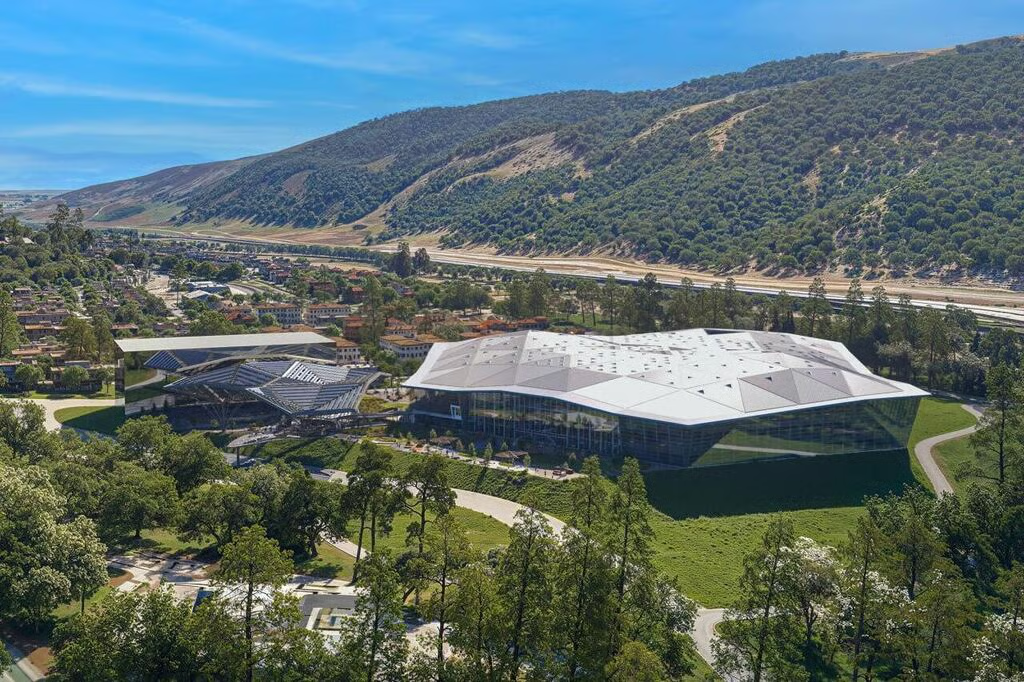
In addition to Nvidia, we’ve seen major acquisitions by Google, Salesforce, ServiceNow, Cisco, Figma, Paypal, etc and new Israel focused partners for A16Z, Sequoia, Greylock, etc.
4. The Engines of 2026: Deep Tech, AI, and Defence
Israel isn’t trying to build another LLM to compete with OpenAI. The ecosystem is pivoting to what it does best: complex, high-barrier engineering, the “picks and shovels” of the new economy.
- Deep Tech Dominance: Israel is now the #1 Deep-Tech hub globally outside the United States. Over 1,500 active deep-tech companies have raised $28.6 billion between 2019 and 2025.
- AI Leadership: In the first half of 2025, 64% of companies raising rounds of $50 million or more were AI companies. Importantly, 56% of these AI founders hold advanced technological degrees (PhDs/MSc), ensuring a depth of innovation that goes beyond simple wrappers.
- Defense Tech: Unsurprisingly, the defense sector is booming, generating $317 million in growth in early 2025 alone, a 92% increase year-over-year.

5. High-Impact Ecosystem: Unicorn Density & The Wealth Cycle
Beyond the technology itself, the structure of the Israeli ecosystem remains unrivaled in its efficiency and ability to regenerate.
- Unicorn Density: Israel is the world leader in high-value companies relative to its size. Adjusting for Gross Domestic Product, Israel takes the top spot globally with 11 unicorns per $100B GDP, surpassing even Singapore (10) and the US.
- The Wealth Flywheel: In 2025, Israeli tech employees cashed out 50 billion NIS (approx. $13.5 billion) through the exercise of stock options. This massive liquidity event does two things: it generates significant tax revenue to fund the war effort, and critically, much of this capital is expected to be recycled back into the ecosystem. As history shows, early employees often become the next generation of angel investors and founders, fueling a new cycle of company creation.

The $1 trillion economy
The GDP in 2025 grew to $550 billion (despite the war). What would it take for it to grow to $1 trillion?
Michael Eisenberg, co-founder and general partner at Aleph, shared his fund’s 2026 annual letter, framing Israel’s tech ecosystem as a beacon of resilience amid global challenges like eroding democracies, resurgent warfare, faltering welfare states, and AI disruption.
He argues that Israel has a unique capacity to cultivate individual agency and grit at scale, positioning it to lead in AI innovation and project a $1 trillion economy within decades, supported by data showing hi-tech exports comprising 55% of GDP and a rebound in 2025 venture funding to $8.5 billion despite war impacts.
The war was a painful, forced descent. But the data from 2025 proves that the ecosystem has reset and is now climbing a steeper, more resilient curve. I’m excited, and grateful for the opportunity to be deploying capital right now in very early stage Israeli AI startups with my partner, Kevin Baxpehler and Remagine Ventures.
The quality of talent, their sense of purpose the the incredible advancements in technology have created the perfect storm for Israeli tech. Since most great companies come after a crisis, I genuinely believe that this will be a very special vintage.

He is a former General Partner at Google Ventures (GV) in Europe, former head of Google for Entrepreneurs in Europe, and founding head of Campus London, Google's first startup hub. Eze writes on Israeli tech, venture capital, artificial intelligence, and founder strategy.
He is also the founder of Techbikers, a nonprofit that brings together the startup ecosystem on cycling challenges in support of Room to Read.
- Your customers don’t care which AI model you use - September 28, 2026
- Weekly Firgun Newsletter – September 24 2026 - September 25, 2026
- AI neo-labs have raised $11.6 billion. What have they shipped? - September 23, 2026