Key takeaways
- Post-training began by teaching models to follow instructions. It now helps agents learn to use tools, make decisions and complete multi-step workflows.
- AI labs buy three distinct inputs for this work: records of how work happens, expert judgment about what good looks like, and simulated environments where agents can practise.
- Verifiable rewards make it possible to reuse a good task across many attempts. The challenge is designing checks that catch mistakes a real customer or operator would care about.
- Private workflow data becomes more valuable when it connects the starting context, the decisions people made and the outcome, with clear rights to license it.
- The strongest suppliers can show that their data improves performance on unfamiliar tasks and keep producing fresh examples as models improve.
A language model can read your refund policy and explain it perfectly. Put it in charge of a real refund and it has a different job. It has to check the order history, notice that the customer has already received a partial refund, and escalate before moving any more money. It can write a convincing email and still get the work wrong.
That gap helps explain why AI labs are buying things that used to look like operational leftovers. An old support ticket shows what the customer said. The order history shows what had already happened. An experienced support lead can explain why the case needed to be escalated. Put those pieces into a simulated store and an agent can practise the decision hundreds of times. Each piece can come from a different supplier.
How post-training became a distinct stage
The appeal of a large pretrained language model was that one model could do many things. Train it to predict the next token across a large corpus and it picks up patterns in language and code. Give it a question, though, and a plausible continuation might be another question. The training objective rewarded predicting text. A user expected the model to understand the assignment and carry it out.
Researchers had already been exploring two ways to close that gap. In 2017, Christiano and colleagues showed that reinforcement learning could use human preferences. In 2020, OpenAI applied that idea to summarisation. In 2021, Google’s FLAN showed that fine-tuning a pretrained model on tasks written as instructions improved its ability to follow instructions on tasks it hadn’t seen.
In 2022, OpenAI’s InstructGPT combined demonstrations, human rankings and reinforcement learning. On sampled API prompts, human evaluators preferred outputs from the 1.3 billion-parameter InstructGPT model to those from the 175 billion-parameter base GPT-3. For anyone assuming that model size would dominate the user experience, that was a striking result. Later that year, Anthropic’s Constitutional AI explored using AI-generated feedback guided by a set of principles. In 2023, Direct Preference Optimization showed that preference pairs could train a model directly, without a separate reward model and reinforcement-learning loop.
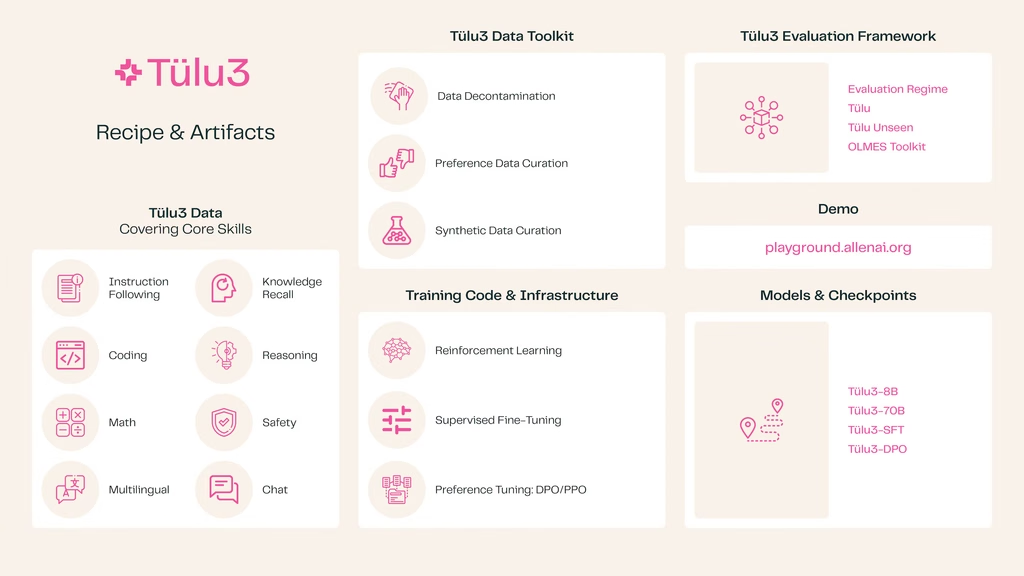
The next step was to train for outcomes you could check. Ai2’s 2024 Tülu 3 release documented a recipe that combined supervised fine-tuning, preference optimisation and reinforcement learning with verifiable rewards. DeepSeek’s 2025 R1 research demonstrated the approach at scale. For R1-Zero, a maths answer could be checked against a known result and a coding answer could be run against test cases. The model could generate its own attempts, and the verifier could supply feedback. That changed what a lab needed to source. A good task and a trustworthy way to grade it could support many rounds of practice.
What counts as post-training?
Post-training adapts a pretrained model through further training. It can teach a model to follow instructions, adopt a style, use tools, reason through problems or carry out a specialised workflow. A single model can go through several of these methods.
| Method | What the model learns from | What a supplier can provide |
|---|---|---|
| Supervised fine-tuning | Examples of a desired response or sequence of actions | Expert-written answers, worked examples and demonstrations of tool use |
| Preference optimisation | Judgments about which outputs are better | Ranked responses and criteria for making the comparison |
| Reinforcement learning | Rewards for the results of its own attempts | Tasks, tests, rubrics, reward models and resettable environments |
| Distillation | Outputs or other signals from a teacher model | Curated prompts, teacher-generated solutions and checks that filter weak examples |
Giving a deployed model access to a document through retrieval changes what it sees at answer time. Building a benchmark measures what it can do. Both can inform post-training, which updates the model’s parameters. Likewise, a lab might buy access to a large archive for pretraining, further domain training or to create post-training tasks. The contract headline rarely tells you which.
What labs are actually buying
The refund case shows how a record becomes a training product. A retailer can license historical cases with their outcomes. A support expert can turn those records into new scenarios and write a rubric. An environment builder can recreate the order system and help desk, let the agent act, then check whether it issued a refund, escalated the case or changed the right records. A separate set of unfamiliar cases can test whether the model learned to apply the policy beyond the examples it saw in training.
OpenAI’s GDPval benchmark gives a sense of how much work it takes to define a realistic task. Experts created 1,320 tasks across 44 occupations, with reference materials and deliverables such as spreadsheets, diagrams and slide decks. Each task went through five rounds of expert review on average. GDPval measures performance, and it illustrates why the people who can design realistic tests are also valuable to teams building training data.

It also explains why private archives can be valuable. A finished video contains the result. The original footage, editor’s timeline and review notes show the choices that produced it. A software release is useful. The issue, patch, tests and code review show why one solution worked and another was rejected. When those pieces can be linked and licensed, buyers can reconstruct the decision instead of guessing from the output.
The AI training data landscape
This November 2026 snapshot maps suppliers by what they publicly offer. Some sell the raw records or expert feedback. Others design the tasks, build the environments or provide the infrastructure to run them. A company can appear in more than one row, and individual lab relationships are often private. The map draws on AIData.Broker’s vendor directory, Toku’s supplier map and Patronus AI’s reinforcement-learning environment landscape.
| Segment | What buyers get | Companies and products |
|---|---|---|
| Managed expert data and post-training | Commissioned demonstrations, preference rankings, complex tasks, grading and sometimes end-to-end training support | Scale AI (Outlier is its contributor platform), Surge AI, Mercor, Turing, Handshake AI, micro1, AfterQuery, Deccan AI, Invisible Technologies, Snorkel AI |
| Expert sourcing and annotation platforms | Access to screened contributors, tools to create and review datasets, and project delivery | Labelbox (Alignerr), SuperAnnotate, Prolific, Pareto.AI, DataAnnotation, Toloka (Mindrift) |
| Established data operations and multilingual collection | Managed annotation, multilingual evaluation and collection across text, audio, images and video | Innodata, Appen, TELUS Digital AI Data Solutions, Centific (OneForma), RWS, TaskUs, Sama, iMerit, CloudFactory |
| Licensed enterprise and professional records | Existing datasets available with permission, including workflow histories and professional artefacts | Troveo, Protege, Mercor’s dataset catalogue, HUD’s DataVendor, Datarade |
| Licensed audio, video and imagery | Speech, visual assets and audiovisual archives through licences or commissioned collection | Troveo, Protege, Defined.ai, Wirestock, Luel, Calliope Networks, Human Native (Cloudflare), Shutterstock |
| Rights holders licensing directly | Access to proprietary archives, community content or structured APIs under specific agreements | Reddit, Stack Overflow, Financial Times, Shutterstock |
| Agent environments and task suites | Resettable applications or codebases, scenarios and scoring for agents | Mechanize, Fleet AI, Veris AI, Bespoke Labs, Plato, Mercor (Deeptune), AfterQuery, Scale AI, Snorkel AI |
| Tools for making data and running environments | Synthetic data generation, curation, environment hosting, orchestration or grading | DatologyAI, NVIDIA NeMo Curator, HUD, Prime Intellect, Patronus AI |


The money is already moving
In 2024, Reuters reported that Google’s deal for access to Reddit content was worth about $60 million a year. In 2025, the news agency reported that Meta invested $14.3 billion in Scale AI. The Reddit deal put a price on access to an existing content archive. Meta’s equity investment showed how strategic a supplier capable of producing training data could become.
This month, Mercor announced a $750 million round at a $20 billion valuation after acquiring agent-environment builder Deeptune. The Information reported that Mercor reached $2 billion in annualised gross revenue in June, calculated by annualising that month’s revenue, and that the company relied heavily on foundation model customers. In September, Snorkel AI raised $350 million at a $3.5 billion valuation. The company told Reuters its annualised revenue run rate had risen from roughly $20 million to more than $350 million in a year as it moved towards delivering finished datasets and training environments.
Buyer concentration is the part I keep coming back to. A few frontier labs can create a large market very quickly. They can also redirect spending when a model gets good enough at a task or they learn how to produce the data themselves. More enterprise buyers could broaden demand, but every company has its own tools, policies and exceptions. A supplier can win more deals and still struggle to reuse the work across them.
What I’d look for as a seed investor
A repeatable way to find the next hard case. A one-time licence can be good revenue for a studio or SaaS company. For a venture-backed supplier, I’d ask what comes back next quarter. Live access to a workflow, a network of specialists who can design harder tasks, or a simulator that can be updated as the tools change all give buyers a reason to return.
Evidence of improvement on unfamiliar tasks. Did the model make fewer policy errors after training? Could a cheaper model do the same job at the same quality? Can the buyer reproduce the result? Synthetic data can make it cheap to generate variants. The harder question is whether those variants expose real weaknesses and whether the grader catches the mistakes that matter.
Rights and economics that hold up at scale. Having the records is the starting point. Who can license them, for which uses, and how much value survives redaction? How much revenue stays with the supplier after paying experts, clearing rights and maintaining environments? Renewal rates and gross margin would tell me more about the durability of the business than a headline run rate.
The company I’d want to back can walk into a specific industry, show where an agent fails today, and turn those failures into examples it can learn from. The strongest case comes six months later, when the model has improved and the customer pays again to teach it the next thing.

He is a former General Partner at Google Ventures (GV) in Europe, former head of Google for Entrepreneurs in Europe, and founding head of Campus London, Google's first startup hub. Eze writes on Israeli tech, venture capital, artificial intelligence, and founder strategy.
He is also the founder of Techbikers, a nonprofit that brings together the startup ecosystem on cycling challenges in support of Room to Read.
- Why AI Labs Are Buying the Data Behind Real Work - November 18, 2026
- AI Can Make More Content. Who Will Pay Attention? - November 17, 2026
- Weekly Firgun Newsletter – November 13 2026 - November 13, 2026
Sources
- - Training language models to follow instructions with human feedback
- - Tülu 3: The next era in open post-training
- - DeepSeek-R1 incentivizes reasoning in LLMs through reinforcement learning
- - Measuring the performance of our models on real-world tasks
- - Organizing human intelligence for the entire economy