Key takeaways
- * AI is expanding EdTech beyond digitised lessons into personalised tutors, adaptive learning and tools that protect deeper skills such as reading, concentration and independent thinking.
- * Experienced Israeli entrepreneurs are validating the opportunity: Moovit founders Roy Bick and Nir Erez are building AI maths tutor Vimi, while Outbrain co-founder Yaron Galai and Amit Elisha launched Yomu to help children rebuild lasting reading habits.
- * Israel has already produced global EdTech successes including Simply, BrainPOP, TinyTap and Kaltura, but investment has remained limited. The combination of AI-native products, proven founders and relatively little sector funding suggests the category may be ready for another look.
Millions of children are about to go back to school. New teachers, new books, new routines and, increasingly, new AI tools.
It is a good moment to shine a spotlight on Israel’s emerging crop of EdTech startups, many of which are using AI to rethink how children learn, practise, create and develop better habits.
The founders entering the category are also worth noticing. After building Moovit, Roy Bick and Nir Erez are developing an AI alternative to private maths tutors. Outbrain co-founder Yaron Galai has returned to entrepreneurship with Yomu, a startup encouraging children to read more books. Other Israeli companies are building conversational tutors, adaptive curricula, creative learning tools and AI-powered feedback for teachers.
Their arrival could be a signal that EdTech is becoming investable again.
The first generation of EdTech largely digitised the existing classroom. Textbooks became videos, worksheets became apps and lectures moved onto learning management systems. Useful, but not fundamentally different.
AI creates the possibility of a much bigger change. Every student could have access to personalised instruction, material adapted to their level and immediate feedback when they get stuck. Teachers could spend less time preparing content and grading repetitive work, giving them more time to focus on the parts of teaching that require human judgement and connection.
Israel has already produced meaningful EdTech successes, including Simply, BrainPOP, TinyTap and Kaltura. Yet the sector continues to attract a fraction of the capital directed towards cybersecurity, fintech and enterprise software.
That gap between proven outcomes, improving technology and limited investment is what makes the current moment interesting. AI is expanding what education software can deliver, just as experienced Israeli entrepreneurs are beginning to take another look at the category.
The new class is starting with Vimi.
From Moovit to AI maths tutors

Vimi is one of the most interesting new entrants. Founded by Moovit co-founders Roy Bick and Nir Erez, the company is building an AI-powered alternative to private maths tutors.
The idea emerged from a familiar parental frustration. Bick’s daughter needed help with sixth-grade maths, but finding a good private tutor was expensive and inconvenient. After selling Moovit to Mobileye for approximately $1 billion, Bick and Erez began exploring whether AI could make personalised tutoring accessible to every child.
Vimi recently emerged from stealth with a $12 million seed round led by Viola Ventures and BRM Group. Its platform combines curriculum coverage, adaptive learning paths, gamification and conversational instruction.
The company believes general-purpose models such as ChatGPT and Claude are not sufficient for the task. They can solve maths problems, but solving the problem is not the same as teaching the student.
A good tutor needs to understand what the student already knows, identify where they are struggling and decide when to explain, ask another question or offer a small hint. Most importantly, the tutor should guide the student towards an answer rather than immediately providing it.
Vimi is attempting to reproduce that experience at software economics. It’s early days, but you can already download the app here.
The opportunity is substantial. Research has long demonstrated the value of one-to-one instruction, but private tutoring remains inaccessible to many families. If AI can deliver something close to that experience at a fraction of the cost, it could expand the tutoring market rather than simply replace existing tutors.
Yomu wants to help kids form a reading habit

Yaron Galai spent much of his career helping people discover digital content. As the co-founder of Outbrain, he helped create the content recommendation category. His new company, Yomu, is focused on helping children rediscover a much older format: books.
Galai founded Yomu with his longtime collaborator Amit Elisha after becoming concerned that children were losing the ability to concentrate on anything longer than a short video or social media post. The app helps children record their reading and gives parents tools to encourage the habit.
Yomu is not an AI tutor in the same way as Vimi. It is better understood as an education company built in response to the AI and attention economy.
As generative AI makes it possible to receive instant answers, summaries and explanations, children may have fewer incentives to read a full book, remain with a difficult argument or use their imagination. Yomu is betting that technology can rebuild those habits rather than accelerate their decline.
The distinction matters. The future of EdTech cannot only be about making learning faster. Some of the most valuable education companies may help children develop the patience, curiosity and independent thinking that an instant-answer world risks weakening.
The fact that Yaron Galai is returning to entrepreneurship in this category is also significant. Experienced founders tend to enter markets when they see a combination of a large problem, a technological shift and the possibility of building a global consumer product. Yomu appears to sit at that intersection.
The new generation of Israeli AI education companies
Beyond Vimi and Yomu, a broader group of Israeli companies is applying AI to different parts of the learning experience.
Jotit is developing a digital learning environment combining handwriting, digital paper, classroom collaboration and AI-powered workflows. The company raised a $10 million seed round in 2025 led by Owl Ventures, one of the world’s leading specialist EdTech investors.
Jotit is not trying to replace handwriting with another distracting screen. It combines the cognitive benefits and simplicity of writing by hand with the organisation, personalisation and analysis made possible by software.
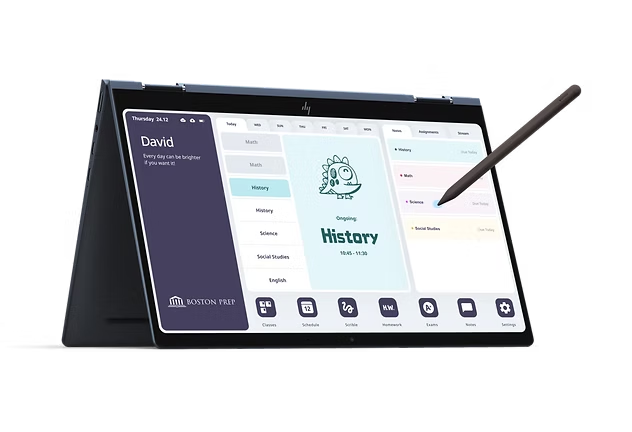
Loora is taking AI tutoring into the global language-learning market. Its app gives learners an always-available English conversation partner that provides immediate feedback on pronunciation, grammar and fluency.
The Tel Aviv company has raised $21.25 million across three rounds. Its product illustrates one of the clearest advantages of AI in education: unlimited practice without the expense, scheduling difficulties or embarrassment that can accompany learning with a human tutor.

Lexi is applying a similar model specifically to children learning English. Its AI tutor uses personalised lessons, bilingual explanations, games and pronunciation coaching to give younger learners more opportunities to practise.
Lexi remains early and has not publicly disclosed institutional funding, but its selection for Meta’s 2026 Israeli startup growth programme makes it an interesting company to watch.
Zoog (Disclosure: a Remagine Ventures portfolio company) founded by Yoav Oren and Matan Guttman, uses AI, augmented reality and animation to turn children’s stories into personalised video experiences. Parents and grandparents can record themselves reading and become characters within the story, helping children engage with books while strengthening family connections across distance.
It started to give grandparents a way to engage with their grandchildren in a fun, digital way, but the company quickly realised that kids use the app to practice their reading and ‘show off’ to their grandparents. The Zoog app is loved by its users and has a 4.9 star rating with over 20,000 reviews.

These companies are pursuing different entry points into education, but they share a move away from simply putting existing content online. The new product is the feedback loop: understanding how a student is progressing, adapting the next interaction and giving teachers greater visibility into where help is needed.
Israel has already produced EdTech winners
Israeli EdTech is not exactly booming, as you can see from the small number of new entrants, but it’s not starting from zero, either.
Simply, formerly JoyTunes, became a unicorn after raising $50 million in 2021. Its Simply Piano, Simply Guitar, Simply Sing and Simply Draw apps demonstrated that learning can become a compelling consumer subscription product when it combines pedagogy with excellent design, gamification and immediate feedback.
BrainPOP, founded by Israeli physician Avraham Kedar, was acquired by KIRKBI, the family holding company behind Lego, for $875 million in 2022.
Animoca Brands acquired a controlling stake in Israeli educational-games platform TinyTap at a valuation of approximately $50 million. Kaltura became a Nasdaq-listed video technology company with a significant education business and later acquired AI avatar company eSelf.
These outcomes show that Israeli founders can build valuable global education companies. What has been missing is a consistent pipeline of new venture-backed startups.
Edtech is a growing market with shrinking funding
The wider EdTech market presents a contradiction. Demand is growing, but venture capital has become harder to secure.
Hyde Park Capital estimates that the global EdTech market was worth approximately $200 billion in 2025 and could reach $473 billion by 2030. Adaptive tutoring, automated assessment and AI-powered course creation are expected to be among its fastest-growing segments.
Funding is moving in the opposite direction. According to HolonIQ, global EdTech startups raised $1 billion in the first half of 2026, down 26% from the same period in 2025.

Investors are still waiting for returns from pandemic-era EdTech bets. Public companies have traded at depressed multiples, while the expiry of pandemic-related education funding has put additional pressure on school budgets.
Even so, EdTech deserves another look
Israel combines strong AI expertise, experience building global consumer products and a culture that places a high value on education. It also faces urgent domestic challenges, including teacher shortages, multilingual classrooms, regional inequality and children whose education has been disrupted by war.
The strongest AI education companies will not simply place a chatbot next to a textbook. They will combine several difficult layers:
- Deep knowledge of the curriculum and learning objectives.
- A model of what each student understands.
- The ability to guide without immediately revealing the answer.
- Interactions appropriate to the child’s age and ability.
- Strong privacy, safety and parental controls.
- Evidence that the product improves learning outcomes.
This is where focused companies can develop an advantage over general-purpose AI platforms. OpenAI, Google and Anthropic can supply much of the underlying intelligence. Specialist startups can build the pedagogy, curriculum alignment, safety layer and trusted relationships with schools and families.
Israel brings strong AI research, experience building global consumer products and a culture that places a high value on education. It also has urgent domestic needs, including teacher shortages, multilingual classrooms, regional inequality and children whose education has been disrupted by war.
The next global Israeli EdTech winner may be an AI tutor, a creative companion, a learning-by-building platform or a product that helps children recover the ability to focus on a book.
The market is growing, funding remains restrained and experienced founders are entering the category.

He is a former General Partner at Google Ventures (GV) in Europe, former head of Google for Entrepreneurs in Europe, and founding head of Campus London, Google's first startup hub. Eze writes on Israeli tech, venture capital, artificial intelligence, and founder strategy.
He is also the founder of Techbikers, a nonprofit that brings together the startup ecosystem on cycling challenges in support of Room to Read.
- Weekly Firgun Newsletter – October 9th 2026 - October 9, 2026
- How Israeli tech changed since October 7 - October 8, 2026
- Building Brakes for Rogue AI - October 5, 2026