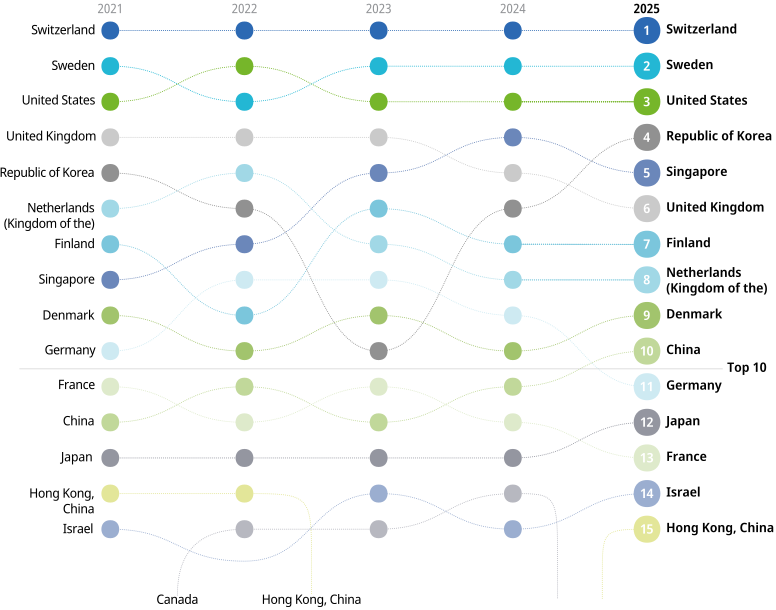
Israel likes to think of itself as the Startup Nation, and for good reason. Few countries of its size have produced such a dense concentration of founders, engineers, venture capital, multinational R&D centres and category-defining companies. In the 2025 Global Innovation Index, Israel ranked 14th globally, while South Korea ranked 4th, Singapore 5th and Japan 12th, placing all of them among the world’s leading innovation economies.
But Israel is not the only small or medium-sized economy trying to turn innovation into national advantage. Across Asia, countries with very different political systems, industrial structures and histories have been asking a similar question: how do we build technological capabilities that matter not just for startups, but for national resilience, economic competitiveness and geopolitical relevance?

This is the core idea I took from Ramon Pacheco Pardo and Robyn Klingler-Vidra’s Foreign Affairs essay, “The Secret to Japanese and South Korean Innovation,” and from their broader argument in Startup Capitalism. Full disclosure: Robyn is my wife, so I’m not exactly a neutral reader. But the book’s core idea is especially relevant for Israel: startups in East Asia are not always framed as rebels that must disrupt incumbents. They are often seen as resources for large companies, tools of industrial renewal and instruments of national strategy.
That is a very different mental model from the classic Silicon Valley mythology: a brilliant founder, a garage, a VC cheque and a mission to destroy the old order. Israel adopted a version of that model extremely well. It helped create a thriving venture ecosystem. It also produced some unintended consequences: too many companies built for early acquisition, too much dependence on foreign capital, not enough local scale-up capacity, and a gap between startup creation and national industrial depth.
Asia offers a useful counterweight.

The common thread: innovation as national capability
Japan, South Korea, Taiwan, Singapore and Israel are very different places, but they share several features that make the comparison useful. They operate in competitive and sometimes threatening geopolitical environments. They cannot rely on natural resources alone. They depend heavily on exports, talent and global markets. They understand that technology leadership is not only about valuation, but about sovereignty.
This is increasingly true for Israel as well. The government’s new National AI Program, approved in June 2026, includes an ambitious target of 100,000 processing units, alongside sovereign compute infrastructure, a national quantum computer, human capital development and international partnerships.
That is the right direction. But infrastructure alone is not a strategy. GPUs are not an ecosystem. The harder question is how Israel connects startups, universities, government, defense, corporates and global markets into a more coherent national innovation system.
This is where Asia becomes interesting.
Japan: make large companies part of the startup system
Japan is often caricatured as slow, corporate and risk-averse. But that misses what is changing. Japan has been putting startups at the centre of a much broader national growth agenda. Its Startup Development Five-Year Plan set ambitious targets: increasing startup investment to ¥10 trillion, creating 100 unicorns and supporting 100,000 startups, while also promoting open innovation with large established companies.
More recently, Japan has gone even bigger. Prime Minister Sanae Takaichi’s 2026 economic blueprint aims to mobilise ¥370 trillion, roughly $2.3 trillion, in combined public and private investment by 2040 across strategic sectors including AI, semiconductors and space.

The lesson for Israel is not that government should pick winners from Jerusalem. The lesson is that large companies should not be treated only as acquirers of Israeli startups or foreign employers of Israeli talent. They can become design partners, distribution channels, manufacturing partners, data partners and anchor customers.
Israel has world-class founders but relatively few large domestic technology companies. That makes the multinational R&D presence important, but also incomplete. Israel needs stronger mechanisms to connect startups with local and global incumbents around areas where the country already has depth: cybersecurity, defense tech, AI infrastructure, health, fintech, agritech, mobility, robotics, semiconductors and creative technologies.
Japan’s model suggests that open innovation works best when it is not left to networking events and corporate theatre. It requires incentives, procurement pathways, legal frameworks and senior-level commitment from industry.
South Korea: let private investors lead, but use public capital to scale
South Korea is one of the world’s most impressive innovation economies. In the 2025 Global Innovation Index, Korea climbed to 4th globally and led the world in the human capital and research pillar, as well as in business-performed R&D and researchers in businesses.
Korea’s startup strategy is particularly relevant for Israel because it does not replace private capital with government capital. Instead, programmes like TIPS use private investors and accelerators as the first filter. TIPS is designed to identify promising startups through accredited private operators, then add government R&D support, mentoring, incubation and global market assistance.
The scale is meaningful. Korea’s Ministry of SMEs and Startups says TIPS has supported approximately 5,000 startups, mobilised KRW 21.3 trillion in private investment, and contributed to 48 public listings since launch. From 2026, Korea plans to expand TIPS into a more integrated framework covering formation, scale-up and global expansion.
Korea is also becoming more explicit about connecting startups with large corporations. Its 2025 plan includes a Deep Tech Value-Up Program to match startups with the needs of large corporations, plus a Value-Up Fund that provides matching investment when large companies invest.
For Israel, this is a powerful idea. The Israel Innovation Authority has long played an important role, and the renewed Yozma Fund is already trying to bring more local institutional capital into Israeli venture. Reuters reported in January 2026 that about $450 million had been directed into local VC funds through public-private programmes, including Yozma, to support Israeli tech innovation.
But the next phase may require more aggressive public-private matching mechanisms in strategic fields. Not generic grants. Not endless committees. But structured programmes where private investors, corporates and government share risk in fields that are too capital-intensive or strategically important for venture capital alone.
AI infrastructure, chips, robotics, quantum, space, defense and bio-convergence all fall into this category. These companies need more than a seed round and a clever deck. They need labs, pilots, compute, regulatory access, procurement, patient capital and global partnerships.
Korea shows that public capital can be catalytic when it follows market signals rather than replacing them.
Taiwan: build a niche superpower, then sustain the ecosystem around it
Taiwan’s innovation lesson is not simply “semiconductors matter.” Everyone now knows that. The deeper lesson is that a country can turn a narrow technological niche into a source of global leverage if it builds the full ecosystem around it.
In a recent piece for The Conversation, Robyn Klingler-Vidra describes Taiwan as a “niche superpower”: a relatively small economy that commands outsized influence because it dominates a strategically indispensable industry. TSMC alone produces more than 90% of the world’s most advanced semiconductor chips, which are essential for smartphones, AI, high-performance computing and advanced military systems.
But Taiwan’s position was not created by TSMC alone. It was built over decades through a dense industrial ecosystem: engineering talent, supplier networks, research institutions, science parks, specialist manufacturing know-how and a deep division of labour across the chip value chain. Hsinchu Science Park became the physical cluster where universities, suppliers, chip designers, foundries and engineers could compound knowledge over time.
That is the part that is hardest to copy. Other countries can subsidise fabs. They can announce chip strategies. They can invest billions. But Taiwan’s edge comes from the accumulated ecosystem around the fabs: the suppliers who know how to respond quickly, the engineers trained in the details of yield improvement, the customers who trust the process, and the culture of operational excellence required to manufacture at the frontier of physics.
For Israel, the lesson is focus and depth. Israel does not need to own every layer of every technology stack. It needs to identify the domains where it can become a niche superpower of its own. Cybersecurity is the obvious example, but the same logic could apply to AI security, defense tech, autonomous systems, robotics, synthetic media, AI infrastructure, quantum software, computational biology or secure cloud infrastructure.
The question is not only whether Israel can produce great startups in these fields. It is whether Israel can build the surrounding ecosystem that allows those startups to compound into national advantage: talent pipelines, suppliers, local customers, procurement, testbeds, research institutions, patient capital and global distribution.

Singapore: orchestrate the ecosystem like a national platform
Singapore may be the most relevant Asian comparator for Israel because it is not a large domestic market, nor does it have the industrial depth of Japan, Korea or Taiwan. Like Israel, it has had to think globally from day one. But Singapore’s innovation model is more coordinated, more deliberately institutional and more tightly connected to national economic planning.
The best example is Singapore’s Research, Innovation and Enterprise strategy. Its RIE2030 plan commits S$37 billion over five years to research, innovation and enterprise, with emphasis on competitiveness, resilience and strategic national priorities.
Singapore also created Startup SG as a unified platform for founders, investors, accelerators and ecosystem builders. Enterprise Singapore describes Startup SG as providing funding and non-financial support to local and global startup enablers, including accelerators that help startups access markets, talent and financing.
The lesson for Israel is coordination. Israel has extraordinary startup density, elite technical talent and global entrepreneurial instincts. But the ecosystem often works despite fragmentation rather than because of orchestration. Singapore shows what a small country can do when innovation policy, talent policy, capital formation, corporate partnerships and national infrastructure are designed to reinforce each other.
As a side note, the public sector is very well regarded in Singapore. It pays well and attracts top talent from the leading universities. Part of their success in their national support plans for startups stems directly from the quality of the talent involved.
The Asian Innovation Strategy Matrix
| Country | Core strategy | What worked | Lesson for Israel |
|---|---|---|---|
| Japan | Startups + corporates + industrial renewal | Open innovation, national tech roadmaps, corporate-startup collaboration | Make corporates real startup partners, not just acquirers |
| South Korea | Public-private startup scaling | TIPS, deep-tech matching, public capital following private selection | Use government funding to amplify market signals |
| Taiwan | Niche superpower | Chips, TSMC, Hsinchu, suppliers, skills, research institutions | Pick strategic niches and build the whole ecosystem around them |
| Singapore | Small-state orchestration | RIE plans, Startup SG, global capital and talent hub | Coordinate capital, talent, infrastructure and policy as one system |
| Israel | Startup Nation 2.0 | Talent, defense tech, cyber, global founders, VC density | Move from startup creation to strategic capability-building |
What should Israel do differently?
Israel does not need to become Japan, Korea, Taiwan or Singapore. Its strengths are different. Israeli founders are impatient, global from day one and comfortable with ambiguity. That should be preserved. The danger is not too much entrepreneurship. The danger is assuming that entrepreneurship alone is enough.
There are five practical lessons Israel can take from Asia.
First, make corporates part of the model. Israel needs more structured collaboration between startups and large companies, both domestic and multinational. This should include procurement pilots, shared testbeds, co-development frameworks and incentives for corporates to invest in and buy from Israeli startups.
Second, use public capital to crowd in private capital. Korea’s TIPS model is a reminder that government funding works best when it leverages private selection. Israel can expand this approach in strategic deep-tech sectors where the market signal exists but the capital requirements exceed normal seed and Series A appetite.
Third, focus national strategy around areas of real advantage. Taiwan’s semiconductor strategy works because it compounds an existing strength. Israel should be equally disciplined. It cannot own the entire AI stack, but it can lead in areas where its existing advantages matter: cyber AI, physical AI, defense-adjacent autonomy, secure infrastructure, AI safety, developer tools, synthetic media, health AI and applied robotics.
Fourth, build infrastructure that startups can actually use. Sovereign compute is important, but the test is access. If only large companies and universities benefit, the impact will be limited. The best Israeli founders should be able to access compute, data, labs, sandboxes and pilot customers without spending a year navigating bureaucracy.
Fifth, update the national story. “Startup Nation” was the right brand for the 2000s and 2010s. The next phase should be about strategic innovation: companies that solve hard problems, strengthen national resilience and compete globally in markets that matter.
From Startup Nation to strategic innovation nation
The countries that will win the next decade of innovation will not be the ones with the most accelerators or the flashiest demo days. They will be the ones that can connect talent, capital, infrastructure, regulation, large customers and global markets around strategic technological capabilities.
Israel already has many of the ingredients. It has elite technical talent, strong venture capital, deep security expertise, entrepreneurial culture and global networks. But Asia shows that the next step is orchestration.
Japan teaches the importance of linking startups with large companies and national industrial priorities. Korea shows how private investors and public capital can work together. Taiwan shows the value of compounding a national strength into adjacent technologies. Singapore shows how a small state can coordinate capital, talent, infrastructure and policy as one national platform.
For Israel, the opportunity is not to abandon the Startup Nation model. It is to evolve it.
The next Israeli success story should not only be a startup that gets acquired by a foreign giant. It should also be a company that becomes part of the country’s strategic infrastructure, creates enduring local capability and sells mission-critical technology to the world.
That is the real lesson from Asia: startups are not only engines of disruption. In the right ecosystem, they are instruments of national power.

He is a former General Partner at Google Ventures (GV) in Europe, former head of Google for Entrepreneurs in Europe, and founding head of Campus London, Google's first startup hub. Eze writes on Israeli tech, venture capital, artificial intelligence, and founder strategy.
He is also the founder of Techbikers, a nonprofit that brings together the startup ecosystem on cycling challenges in support of Room to Read.
- What it takes to raise a pre-seed, seed and Series A in 2026 - October 1, 2026
- Your customers don’t care which AI model you use - September 28, 2026
- Weekly Firgun Newsletter – September 24 2026 - September 25, 2026